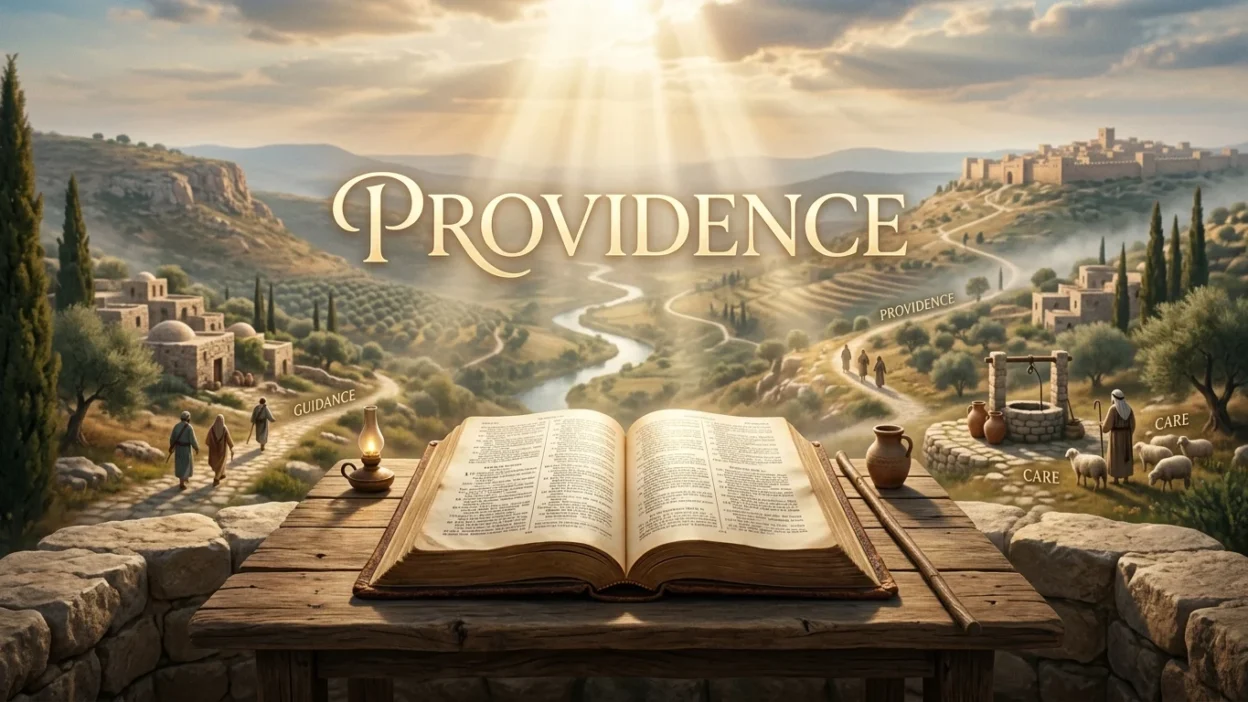
The providence meaning in the Bible is closely connected with God’s care, guidance, provision, and control over His creation. Biblical providence describes the way God continually sustains the world and works through circumstances to accomplish His purposes. It reminds believers that God is not distant from human life but remains involved in what He has created.
The providence meaning in the Bible can be seen throughout Scripture, even though the word “providence” itself is not commonly used in many Bible translations. Stories such as Joseph’s journey from slavery to leadership, Esther’s role in saving her people, and God’s provision for His people show the idea of divine providence. For Christians, providence offers comfort because it teaches that God can work through both ordinary events and difficult seasons.
Quick Answer
Providence in the Bible means God’s ongoing care, guidance, provision, and sovereign work in creation. It describes how God sustains His creation and works through circumstances to fulfill His purposes.
What Does Providence Mean in the Bible?
Providence refers to God seeing, providing, sustaining, and guiding according to His wisdom and purpose.
The concept includes several ideas:
- God sustains creation.
- God provides for His creatures.
- God can guide circumstances.
- God works toward His purposes.
- God remains present during difficult times.
Providence does not mean that everything people experience is easy or that every event is immediately understood.
| Aspect | Biblical Idea |
|---|---|
| Providence | God’s continuing care and guidance |
| Provider | God supplies what His creation needs |
| Sovereignty | God has ultimate authority |
| Guidance | God can work through circumstances |
| Purpose | God works according to His wisdom |
| Human Response | Trust, prayer, obedience, and faith |
Biblical Origin of Providence
The English word providence comes from Latin roots connected with the idea of seeing beforehand or foreseeing.
The biblical concept, however, is broader than simply knowing the future.
It includes God’s continuing involvement with His creation.
The Bible repeatedly describes God as the One who creates, sustains, provides, guides, and accomplishes His purposes.
Is Providence Mentioned in the Bible?
The word itself may not appear frequently in modern Bible translations, but the idea of divine providence is found throughout Scripture.
For example, Jesus taught about God’s care for birds and flowers in Matthew 6:25–34.
He encouraged His followers not to live controlled by anxiety but to trust their heavenly Father.
This provides an important picture of God’s providential care.
Providence and God’s Provision
One major part of providence is provision.
Jesus taught that God knows what His people need.
Matthew 6 emphasizes God’s care for creation and encourages believers to seek God’s kingdom rather than being consumed by worry about everyday needs.
This does not mean Christians will receive everything they want.
Instead, providence points toward trusting God’s wisdom and care.
Spiritual Meaning of Providence
The spiritual meaning of providence can be understood through several important themes.
God’s Care
Providence reminds believers that God cares about His creation.
God’s Guidance
God can use circumstances, people, opportunities, and Scripture to guide people toward wise choices.
God’s Sovereignty
Providence points to God’s authority over creation and history.
God’s Provision
Believers can trust God while responsibly working, planning, and making wise decisions.
God’s Purpose
Even when circumstances are difficult to understand, Christians can trust that God is not limited by them.
Joseph as an Example of Providence
The story of Joseph in Genesis is one of the clearest biblical examples often connected with providence.
Joseph experienced betrayal, slavery, imprisonment, and eventually leadership in Egypt.
Looking back on his life, Joseph recognized that God could use what others intended for harm to accomplish a greater purpose.
Genesis 50:20 expresses this powerful idea.
Joseph’s story does not suggest that everything that happened to him was good.
Rather, it shows that God could work through terrible circumstances and bring about a greater outcome.
Esther and Divine Providence
The book of Esther provides another powerful example.
Interestingly, God’s name is not explicitly mentioned in the Hebrew text of Esther.
Yet the story unfolds through a remarkable series of circumstances.
Esther becomes queen, Mordecai discovers a plot, and events eventually lead to the protection of the Jewish people.
Many readers see this unfolding story as a beautiful picture of providence: God working through circumstances even when His presence is not obvious.
Providence and Free Will
A common question is whether God’s providence means humans have no choices.
The Bible presents both God’s sovereignty and human responsibility.
People make real decisions and are responsible for their actions.
At the same time, Scripture teaches that God remains sovereign over His creation.
Christians have different theological explanations for how these truths fit together, but both themes appear throughout Scripture.
Providence vs Miracle
| Providence | Miracle |
|---|---|
| Often works through ordinary circumstances | Involves an extraordinary act |
| May not be immediately obvious | Usually more clearly supernatural |
| Can involve people and events | Directly displays God’s extraordinary power |
| Often unfolds gradually | May happen at a specific moment |
| Example: Joseph’s changing circumstances | Example: Jesus raising Lazarus |
Providence does not require a dramatic supernatural event.
Sometimes God’s work may appear through ordinary events and decisions.
Providence vs Coincidence
People sometimes wonder whether an unexpected event is coincidence or providence.
The Bible encourages believers to trust God rather than obsessively searching for hidden messages in every event.
A Christian may look back on a situation and recognize how God provided an opportunity, protection, relationship, or direction.
But wisdom is important.
Not every coincidence should automatically be declared a supernatural sign.
Why Do People Search “Providence Meaning in the Bible”?
People often search this topic because they want to understand:
- Whether God is involved in their lives.
- How God guides people.
- What God’s provision means.
- Whether difficult circumstances can have a purpose.
- How God’s sovereignty works.
- How biblical stories demonstrate God’s care.
Providence can be especially comforting when life feels uncertain.
Providence During Difficult Times
One of the most encouraging aspects of biblical providence is that God’s care does not depend on perfect circumstances.
Joseph’s story is a good example.
His early life contained tremendous hardship, yet his story did not end there.
The biblical message is not that every painful experience will immediately make sense.
Rather, believers can continue trusting God even when they cannot see the entire picture.
How Can Christians Trust God’s Providence?
Trusting God’s providence does not mean sitting back and doing nothing.
Believers can:
- Pray for wisdom.
- Study Scripture.
- Make responsible decisions.
- Seek wise advice.
- Work faithfully.
- Remain patient.
- Trust God with outcomes.
Faith and responsible action can work together.
Common Misconceptions About Providence
Myth: Providence means everything that happens is good.
Truth: The Bible contains suffering, injustice, and human wrongdoing. Providence means God can work through circumstances without making wrongdoing morally good.
Myth: Providence means you should never make plans.
Truth: Scripture encourages wisdom and planning while recognizing that God ultimately guides circumstances.
Myth: Every unexpected event is definitely a divine sign.
Truth: Christians should use Scripture and wisdom rather than assigning a supernatural meaning to every coincidence.
Myth: Providence means Christians will never suffer.
Truth: Biblical examples show that faithful people can experience serious hardship while still trusting God’s care.
What Can Providence Teach Christians?
The biblical concept of providence teaches several valuable lessons.
Trust: God remains worthy of trust even when circumstances are unclear.
Patience: God’s purposes may unfold over time.
Prayer: Believers can bring their needs and decisions to God.
Humility: Humans cannot always see the whole picture.
Hope: Difficult circumstances do not necessarily represent the end of God’s work.
Final Thought
The providence meaning in the Bible points to God’s continuing care, provision, guidance, and sovereign involvement in His creation. Although the word itself is not central in most Bible translations, the concept appears throughout Scripture. Joseph’s story shows how God can work through painful circumstances, while Esther’s story demonstrates how events can unfold in ways that protect God’s people even when His presence is not obvious. Biblical providence does not mean that everything that happens is good or that believers will never experience hardship. Instead, it encourages Christians to trust that God remains wise and purposeful even when they cannot see the whole picture. Providence invites believers to pray, act wisely, remain faithful, and trust God with outcomes they cannot control.
FAQs
What does providence mean in the Bible?
Providence refers to God’s ongoing care, provision, guidance, and sovereign work within His creation.
Is the word providence in the Bible?
The exact word varies by Bible translation, but the concept of God’s providential care is found throughout Scripture.
What is an example of God’s providence?
Joseph’s story in Genesis is a well-known example because God worked through Joseph’s difficult circumstances to accomplish a greater purpose.
What is the spiritual meaning of providence?
Spiritually, providence represents trusting God’s care, wisdom, guidance, provision, and purpose even when circumstances are difficult.
Does providence mean everything happens for a reason?
Christian traditions differ in how they explain this phrase. Biblically, God can work through circumstances, but Scripture does not teach that human wrongdoing or suffering is morally good simply because God can bring good from it.
What is the difference between providence and a miracle?
Providence often works through ordinary circumstances and events, while a miracle is an extraordinary act of God.
How can I trust God’s providence?
You can pray, study Scripture, seek wisdom, make responsible choices, remain patient, and trust God with outcomes beyond your control.