
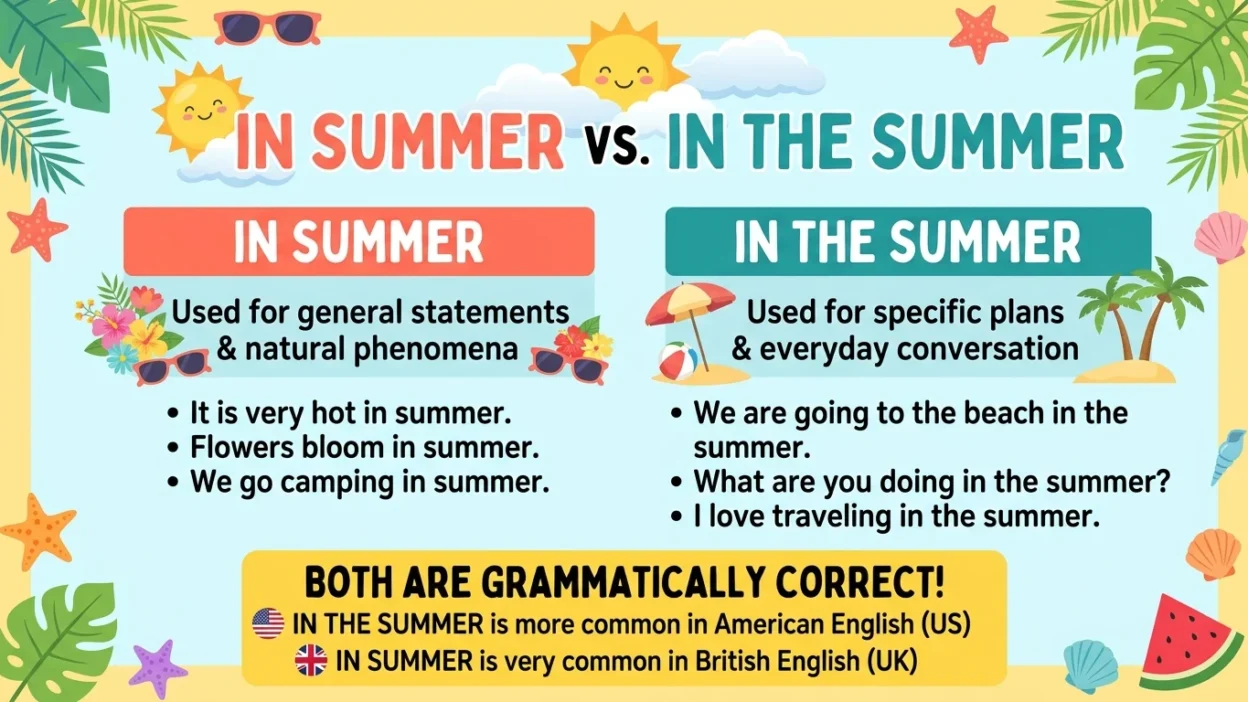
The phrases in summer vs in the summer are both grammatically correct, but they are used slightly differently depending on the context, speaking style, and variety of English. Both phrases refer to the summer season, but the small difference is the use of the article the. Understanding when to say “in summer” and when to say “in the summer” can help you sound more natural and confident in everyday English.
Many English learners wonder whether the word the is necessary when talking about seasons. The answer is that both expressions are acceptable in American English, but in the summer is generally more common in everyday American conversation. The shorter phrase in summer is also correct and is often used when speaking about seasons in a general sense, particularly in British English.
Quick Answer: In Summer vs In the Summer
In summer and in the summer both mean during the summer season. In American English, in the summer is generally more common in everyday speech. In summer is also correct, especially when discussing seasons generally. The choice depends on context and regional preference.
Why Do People Confuse In Summer and In the Summer?
People often confuse these expressions because they have almost identical meanings. The only noticeable grammatical difference is the article the.
In English, articles such as a, an, and the can change how we refer to nouns. However, seasons are sometimes used with an article and sometimes without one.
For example:
- I enjoy swimming in summer.
- I enjoy swimming in the summer.
Both sentences are correct and communicate the same general idea.
The confusion usually comes from learning that singular countable nouns often need articles. However, season names can be used without the when referring to a season generally.
What Does In Summer Mean?
In summer means during the summer season. It is commonly used to describe general habits, seasonal activities, weather patterns, and things that regularly happen during summer.
It does not require the article the before the season name.
Definition of In Summer
The expression in summer refers to the summer season as a general period of the year.
It is particularly common in British English and is also grammatically correct in American English.
Examples:
- Flowers usually bloom in summer.
- We enjoy going swimming in summer.
- Days are often longer in summer.
- Many families travel in summer.
- The weather becomes warmer in summer.
Grammatical Structure of In Summer
The expression follows this basic structure:
In + Summer
Here:
- In = Preposition.
- Summer = Noun.
The preposition in indicates a period of time, while summer identifies the season.
When to Use In Summer
Use in summer when discussing seasonal activities, general facts, or habits that happen during the summer season.
General seasonal statements:
People often visit the beach in summer.
Weather descriptions:
It rains frequently in summer in some regions.
Regular activities:
My family goes camping in summer.
Seasonal preferences:
I prefer wearing light clothes in summer.
What Does In the Summer Mean?
In the summer also means during the summer season. It is widely used in American English, especially in everyday conversations.
The word the makes the expression refer to the summer season as a recognizable period of the year.
Definition of In the Summer
The phrase in the summer refers to activities, events, weather conditions, or experiences that happen during the summer season.
It is a natural and common expression in American English.
Examples:
- We usually visit our grandparents in the summer.
- The children enjoy playing outside in the summer.
- I like drinking cold lemonade in the summer.
- Many people go on vacation in the summer.
- The temperature often rises in the summer.
Grammatical Structure of In the Summer
The expression follows this structure:
In + The + Summer
Here:
- In = Preposition.
- The = Definite article.
- Summer = Noun.
The article the identifies summer as a particular season or period within the yearly cycle.
When to Use In the Summer
Use in the summer when talking about seasonal experiences, personal plans, activities, and general statements.
Everyday conversations:
We spend more time outdoors in the summer.
Travel plans:
My family is visiting California in the summer.
Personal experiences:
I learned how to swim in the summer.
Seasonal activities:
Children often have more free time in the summer.
In Summer vs In the Summer: Key Differences
Both expressions describe the same season, but there are some differences in usage and regional preference.
| Comparison | In Summer | In the Summer |
|---|---|---|
| Meaning | During summer | During summer |
| Grammar | Correct | Correct |
| Article | No article | Uses “the” |
| American English | Correct, less common in everyday speech | Very common |
| British English | Very common | Also correct |
| Formal writing | Acceptable | Acceptable |
| General meaning | Yes | Yes |
| Example | Flowers bloom in summer. | Flowers bloom in the summer. |
The main difference is not the meaning but the style and regional preference.
Is In Summer or In the Summer More Common in American English?
For American readers and speakers, in the summer is generally the more natural and frequently used expression in everyday conversation.
For example:
- We go camping in the summer.
- I enjoy spending time with my family in the summer.
- The weather is extremely hot in the summer.
However, in summer is not incorrect in American English.
You can use either expression without changing the basic meaning of your sentence.
American vs British English: In Summer vs In the Summer
The use of articles with seasons can vary between American and British English.
| Context | American English | British English |
|---|---|---|
| Talking about summer generally | In the summer | In summer |
| Seasonal activities | In the summer | In summer |
| Talking about a particular summer | In the summer | In the summer |
| General seasonal statement | Both are correct | Both are correct |
American English example:
We usually travel to the beach in the summer.
British English example:
We usually travel to the beach in summer.
These are regional preferences, not strict grammar rules. Both expressions are understood by English speakers in the United States and the United Kingdom.
Can You Say In Summer Without The?
Yes, absolutely! You do not always need the before a season.
In English, seasons can be used with or without the definite article when referring to periods of the year.
For example:
- I love traveling in summer.
- Birds are more active in spring.
- The leaves change color in autumn.
- It often snows in winter.
These sentences are grammatically correct.
However, American speakers often prefer expressions such as in the spring, in the summer, in the fall, and in the winter.
Can You Say In the Summer for a Specific Year?
Yes. You can use in the summer when referring to a particular year or a specific summer period.
Examples:
- I visited New York in the summer of 2024.
- We moved to Texas in the summer of 2022.
- She started college in the summer of 2025.
You can also say in summer 2025, although in the summer of 2025 is a very natural choice in American English.
The additional words help identify the exact summer you are discussing.
Common Mistakes When Using In Summer and In the Summer
Although both expressions are correct, learners sometimes make mistakes when using them in sentences.
Mistake 1: Thinking In Summer Is Incorrect
Incorrect assumption: You must always use the before summer.
Correct understanding: Both in summer and in the summer are grammatically correct.
Mistake 2: Mixing Articles Unnecessarily
Incorrect: I enjoy swimming in the a summer.
Correct: I enjoy swimming in the summer.
Explanation: Do not use a and the together before the season in this expression.
Mistake 3: Confusing In Summer With On Summer
Incorrect: We usually travel on summer.
Correct: We usually travel in the summer.
Explanation: Use in when referring to a season as a period of time.
Mistake 4: Using At Instead of In
Incorrect: My family visits us at the summer.
Correct: My family visits us in the summer.
Explanation: The preposition in is normally used when referring to seasons.
Mistake 5: Assuming British and American Usage Is Identical
Both varieties accept the two expressions, but their preferences can differ. American speakers generally use in the summer more often, while British speakers commonly use in summer.
Easy Memory Trick to Remember the Difference
Here is a simple way to remember both expressions:
- In summer: A shorter expression, commonly preferred in British English.
- In the summer: A common expression in American English.
Remember that both phrases mean during the summer season.
If you are writing for an American audience, choosing in the summer is usually a safe and natural option.
Similar and Related Expressions
Understanding other seasonal expressions can help you use English prepositions more confidently.
| Expression | Example |
|---|---|
| In spring | Flowers bloom in spring. |
| In the spring | We travel in the spring. |
| In summer | Schools often close in summer. |
| In the summer | We visit the beach in the summer. |
| In autumn | Leaves change color in autumn. |
| In the fall | The weather gets cooler in the fall. |
| In winter | It often snows in winter. |
| In the winter | We stay indoors in the winter. |
Notice that American English commonly uses fall instead of autumn, although both words are understood.
Frequently Asked Questions
Is it in summer or in the summer?
Both expressions are correct. They mean during the summer season. However, American English speakers generally prefer in the summer in everyday conversation, while in summer is particularly common in British English.
Do Americans say in summer or in the summer?
Americans commonly say in the summer. It is a natural expression in everyday conversations, emails, and general writing. However, Americans can also use in summer without making a grammatical mistake.
Is in summer grammatically correct?
Yes, in summer is grammatically correct. The word the is not always necessary before season names. For example, “I enjoy swimming in summer” is a perfectly acceptable English sentence.
Why do British people say in summer?
British English commonly uses season names without the definite article when discussing seasons generally. For example, “We go on holiday in summer.” However, British speakers also use in the summer.
Should I use the in the summer?
You can use the when saying in the summer. This expression is especially common in American English. The article is grammatically appropriate, and the complete phrase sounds natural in everyday speech.
Can I use in the summer in formal writing?
Yes, in the summer is perfectly acceptable in formal writing. You can also use in summer. The choice depends on your writing style, audience, and regional preference rather than a strict formal grammar rule.
What is the difference between in summer and during the summer?
Both expressions refer to the summer season. However, in summer is a shorter seasonal expression, while during the summer emphasizes the period when something happens. For example, “I travel in summer” and “I travel during the summer” have nearly identical meanings.
Remember This
- Both in summer and in the summer are correct.
- Both expressions mean during the summer season.
- American English generally favors in the summer.
- British English commonly uses in summer.
- The word the is optional in these general seasonal expressions.
- Use in, not on or at, when referring to a season.
Conclusion
The difference between in summer and in the summer is mainly about regional preference and writing style, not meaning. Both expressions are grammatically correct and refer to the same season. However, American English speakers generally prefer in the summer, while British English speakers commonly use in summer. Understanding this difference can help you communicate more naturally and avoid unnecessary grammar confusion.
If you are writing for an American audience, in the summer is usually the best everyday choice. Nevertheless, you can confidently use in summer when it fits your sentence and writing style. The most important thing to remember is that neither expression is wrong, and both are widely understood.

Olivia Brooks is an American writer with a passion for creating informative and reader-friendly content. She specializes in breaking down complex topics into simple, engaging articles. Her work is guided by thorough research, accuracy, and a genuine desire to help readers learn something new. Olivia enjoys writing about faith, personal growth, symbolism, and everyday life. She believes that meaningful content should inspire curiosity while remaining easy to understand. Her friendly writing style has earned the trust of readers from around the world. Outside of writing, Olivia enjoys traveling, photography, and spending time with family. She is dedicated to producing content that is both valuable and enjoyable.