Have you ever wondered whether to use “if so” or “if yes” in English? Both expressions are grammatically possible, but they are not always interchangeable. While native English speakers commonly use “if so,” you may notice that “if yes” appears less frequently in everyday conversations. This difference often confuses English learners, students, and even experienced writers.
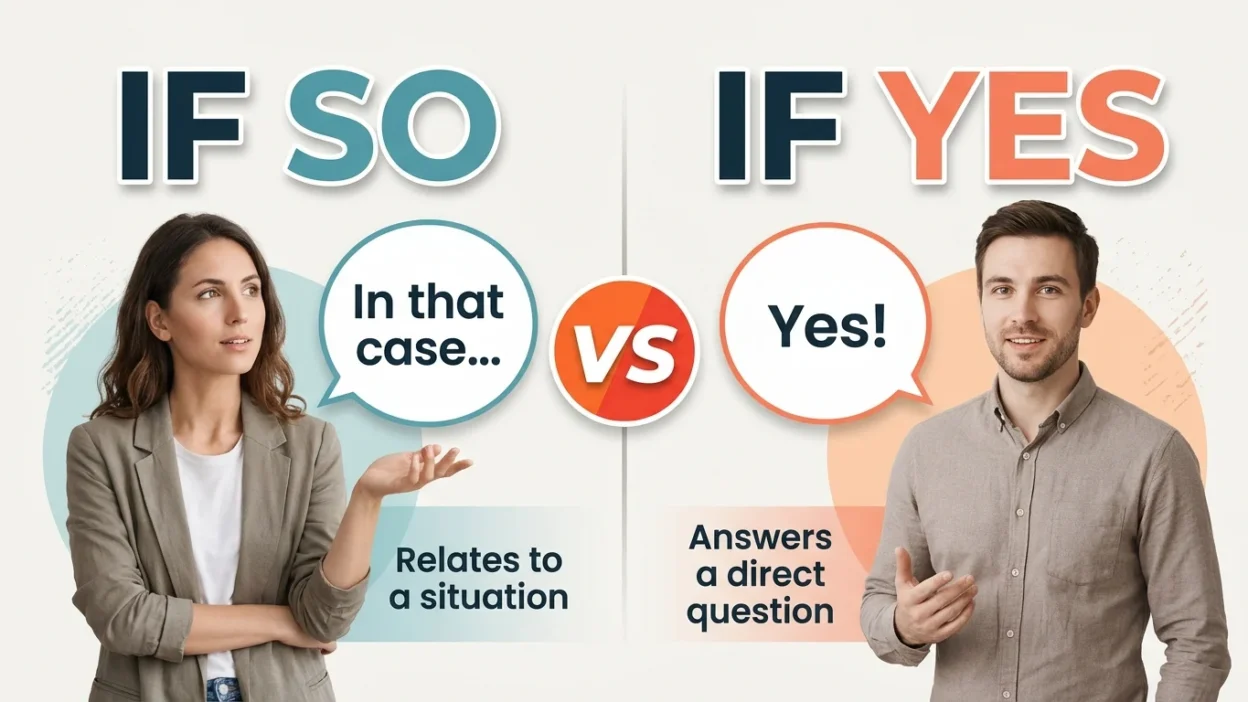
The main difference is that “if so” means “if that is the case,” whereas “if yes” means “if the answer is yes.” The expression “if so” can refer to a situation, statement, or possibility, even when there is no direct yes-or-no question. In contrast, “if yes” specifically refers to an affirmative answer to a question that expects a yes-or-no response.
Understanding this distinction will help you choose the more natural expression in everyday American English, professional emails, academic writing, and conversations.
Quick Answer: If So vs. If Yes
If so means “if that is the case” and refers to something previously mentioned. If yes means “if the answer is yes” and generally follows a clear yes-or-no question. Both expressions are correct, but “if so” is more flexible and usually sounds more natural in everyday English. Use “if yes” when you specifically want to emphasize an affirmative answer.
Is There a Difference Between If So and If Yes?
Yes, there is a difference in meaning, usage, and naturalness.
Although both expressions introduce a condition, they refer to different things.
- If so: Refers to a previously mentioned fact, situation, possibility, or statement.
- If yes: Refers specifically to a positive answer to a yes-or-no question.
For example:
If so:
Are you planning to study abroad? If so, you should research the universities first.
If yes:
Did you submit your application? If yes, check your email for confirmation.
In the first example, “if so” refers to the possibility of studying abroad. In the second, “if yes” refers directly to a positive answer about submitting an application.
The important point is that “if yes” is not grammatically incorrect. However, it has a narrower use than “if so,” which explains why native English speakers often prefer “if so.”
What Does If So Mean?
If so is a common English expression that means “if that is true,” “if that is the case,” or “if what was just mentioned applies.”
It connects a previous statement or situation to a possible action, result, or consequence.
Native English speakers frequently use this expression in everyday conversations, business communication, emails, and formal writing.
If So: Definition and Grammar
The expression consists of two parts:
- If: A subordinating conjunction that introduces a condition.
- So: An adverb or pro-form referring back to a previously mentioned fact, statement, or situation.
Together, they form a conditional expression.
For example:
Are you interested in learning English? If so, join our online course.
Here, “so” refers to being interested in learning English. Instead of repeating the entire condition, the speaker uses two simple words.
5 Examples of If So in Everyday English
- Are you ready for the interview? If so, let’s get started.
- Is the restaurant open today? If so, we can have dinner there.
- Do you need help with your homework? If so, call me.
- Have you completed your English course? If so, update your resume.
- Are you planning to visit California? If so, book your hotel early.
When Should You Use If So?
Use if so in English sentences when:
- You want to refer to a previously mentioned situation.
- You want to avoid repeating information.
- You are discussing a possible result or consequence.
- The previous statement is not limited to a yes-or-no answer.
- You want natural and fluent English in conversations or writing.
Example:
I am not sure whether the company has announced its new training program. If so, I would like to register.
This sentence is natural because “if so” refers to the possibility that the company has announced the program.
What Does If Yes Mean?
If yes means “if the answer is yes” or “if someone gives an affirmative response.”
It is used when the speaker specifically wants to refer to a positive answer rather than a situation more generally.
Although it is less common than “if so” in ordinary conversation, it is still grammatically correct in suitable contexts.
If Yes: Definition and Grammar
The expression contains two parts:
- If: A subordinating conjunction that introduces a condition.
- Yes: An adverb or interjection used to express an affirmative response.
Together, they communicate that something will happen if the answer to a question is positive.
For example:
Did you receive the invitation? If yes, please confirm your attendance.
Here, “if yes” means “if your answer to the question is yes.”
5 Examples of If Yes in Everyday English
- Did you receive my email? If yes, please reply today.
- Have you completed the registration? If yes, check your confirmation message.
- Are you available on Monday? If yes, let me know.
- Do you agree with the proposal? If yes, sign the document.
- Have you paid the application fee? If yes, keep the receipt.
When Should You Use If Yes?
Use if yes in English when:
- You are responding to a direct yes-or-no question.
- You are completing a questionnaire or survey.
- You want to distinguish a positive answer from a negative one.
- You are providing instructions based on an affirmative response.
- You are discussing a situation where the answer is clearly yes or no.
Example:
Are you legally eligible for this program? If yes, complete Form A before submitting your application.
Here, “if yes” is appropriate because the question expects a specific affirmative or negative answer.
Why Is If So More Common Than If Yes?
One of the most interesting differences between these expressions is their frequency and flexibility.
Native English speakers generally prefer “if so” over “if yes” because “so” can refer to a broader situation or idea.
On the other hand, “yes” specifically refers to an affirmative answer.
Consider these examples:
Example 1: A direct yes-or-no question
Did you receive the documents?
- If so, please sign them.
- If yes, please sign them.
Both are possible, although “if so” generally sounds more natural in ordinary conversation.
Example 2: An indirect question
I wanted to know whether you received the documents; if so, please sign them.
Here, “if so” is natural because it refers to the possibility expressed in the previous clause.
Using “if yes” in this sentence would sound awkward to many native English speakers.
Example 3: A situation that is not strictly yes or no
Have you had a chance to watch some of the training videos? If so, we would appreciate your feedback.
This is more natural than “if yes” because someone might have watched one video, several videos, or only part of a video.
The situation is not necessarily a simple yes-or-no choice.
The key takeaway: “If so” works with broader situations and indirect conditions, while “if yes” is most appropriate when a clear affirmative answer is expected.
If So vs. If Yes: Complete Comparison Table
| Feature | If So | If Yes |
| Meaning | If that is the case | If the answer is yes |
| Main purpose | Refers to a previous situation | Refers to an affirmative answer |
| Usage | Broad and flexible | More specific |
| Commonness | More common | Less common |
| Naturalness | Generally more natural | Context-dependent |
| Direct questions | Yes | Yes |
| Indirect questions | Natural | Often awkward |
| Formal writing | Appropriate | Appropriate in suitable contexts |
| Everyday conversation | Very common | Less frequent |
| Example | Are you ready? If so, let’s go. | Did you agree? If yes, sign here. |
Can You Use If So and If Yes Interchangeably?
Sometimes, yes. However, the expressions are not always interchangeable.
When a question has a clear yes-or-no answer, both expressions may work.
For example:
Did you finish your assignment?
- If so, submit it today.
- If yes, submit it today.
Both sentences are grammatically possible.
However, consider this example:
I wanted to know whether you were interested in joining our company; if so, please send your resume.
Here, “if so” is the natural choice. “If yes” sounds awkward because the sentence refers to an indirect question rather than a direct yes-or-no response.
Therefore, the best expression depends on the sentence structure and the meaning you want to communicate.
10+ Practical Examples: If So vs. If Yes
Here are additional examples from everyday situations to help you understand the difference between these expressions.
Examples Using If So
| Situation | Example |
| Education | Are you preparing for an exam? If so, study regularly. |
| Employment | Are you looking for a new job? If so, update your resume. |
| Shopping | Is this product available? If so, order it online. |
| Technology | Is your computer working properly? If so, continue your work. |
| Travel | Are you visiting New York? If so, check the weather forecast. |
| Learning | Do you want to improve your English? If so, practice every day. |
Examples Using If Yes
| Situation | Example |
| Education | Did you pass the examination? If yes, congratulations! |
| Employment | Did you receive the job offer? If yes, review the contract. |
| Shopping | Did you purchase the product? If yes, save your receipt. |
| Technology | Have you installed the update? If yes, restart your device. |
| Registration | Have you registered online? If yes, check your email. |
| Business | Do you approve this proposal? If yes, sign the agreement. |
These if so and if yes examples show that both expressions are useful, but their natural usage depends on whether you are referring to a general situation or a direct affirmative answer.
Common Mistakes When Using If So and If Yes
English learners sometimes confuse these expressions because they have similar conditional meanings.
Here are common mistakes and their corrections.
1. Assuming If Yes Is Always Incorrect
Incorrect assumption:
You should never use “if yes” in English.
Correct explanation:
“If yes” is grammatically acceptable when referring to an affirmative answer to a yes-or-no question.
2. Using If Yes in Every Situation
Less natural:
I wanted to know whether you were interested; if yes, contact me.
More natural:
I wanted to know whether you were interested; if so, contact me.
The second sentence is more natural because it refers to an indirect question.
3. Using If So Without Previous Context
Unclear:
If so, please send the document.
Better:
Have you completed the application? If so, please send the document.
The reader needs enough context to understand what “so” refers to.
4. Confusing If So With If Not
Incorrect:
Are you coming to the meeting? If not, we will start without you.
This is not incorrect grammar, but it changes the meaning. “If not” refers to the negative condition, not the positive one.
Correct positive version:
Are you coming to the meeting? If so, we will wait for you.
5. Repeating the Entire Condition Unnecessarily
Less concise:
Are you interested in the course? If you are interested in the course, register today.
Better:
Are you interested in the course? If so, register today.
Using “if so” makes the sentence shorter and more natural.
An Easy Memory Trick: How to Remember the Difference
You can remember the difference between if so vs. if yes with these two simple rules.
IF SO = IF THAT IS THE CASE
Use it when referring to a previous statement, situation, or possibility.
Example:
Are you feeling better? If so, you can return to work.
IF YES = IF THE ANSWER IS YES
Use it when referring specifically to an affirmative answer.
Example:
Did you complete the form? If yes, submit it now.
A simple way to remember:
- If so = Situation
- If yes = Yes answer
This memory trick will help you choose the correct expression when speaking or writing English.
American English vs. British English: Is There a Difference?
There is no significant grammatical or spelling difference between American English and British English when using “if so” and “if yes.”
Both expressions are understood in the United States and the United Kingdom.
However, “if so” is generally more natural and widely used in everyday communication in both varieties of English.
“If yes” is also acceptable, particularly in questionnaires, forms, instructions, and contexts where an explicit affirmative answer matters.
The difference is mainly about meaning, context, and natural usage rather than regional English rules.
Similar and Related Expressions
Learning related expressions can help you improve your English vocabulary and understand different conditional sentence structures.
| Expression | Meaning | Example |
| If not | If that is not the case | Are you busy? If not, call me. |
| If true | If the statement is correct | If true, this is important news. |
| If that’s the case | If the situation is as described | If that’s the case, we should leave. |
| If that’s true | If the information is correct | If that’s true, I am surprised. |
| If the answer is yes | If someone answers positively | If the answer is yes, continue. |
| If the answer is no | If someone answers negatively | If the answer is no, select another option. |
| Otherwise | If something different happens | Hurry up; otherwise, we will be late. |
| In that case | If that situation applies | In that case, let’s start tomorrow. |
These alternative expressions for if so and if yes can make your writing more varied and precise.
Frequently Asked Questions
1. Is If Yes Grammatically Correct in English?
Yes. “If yes” is grammatically correct when referring to an affirmative answer to a yes-or-no question. However, it is less common than “if so” in everyday conversation and may sound unnatural when used after indirect questions.
2. Why Do Native Speakers Say If So Instead of If Yes?
Native English speakers often prefer “if so” because it refers to a broader situation rather than requiring a direct yes-or-no answer. It also works naturally after statements and indirect questions, making it more flexible in everyday communication.
3. What Is the Main Difference Between If So and If Yes?
“If so” means “if that is the case” and refers to a previously mentioned situation. “If yes” means “if the answer is yes” and specifically refers to an affirmative response. Both are correct, but their uses differ.
4. Can I Say If Yes After a Yes-or-No Question?
Yes. You can say “if yes” after a direct yes-or-no question. For example, “Did you receive the invitation? If yes, please reply.” However, “if so” would also work and often sounds more natural.
5. Can I Use If So After an Indirect Question?
Yes. “If so” works naturally after indirect questions because it refers to the situation or possibility being discussed. For example: “I wanted to know whether you had completed the assignment; if so, please send it.”
6. Which Is Better for Formal Emails: If So or If Yes?
“If so” is generally the better choice for professional emails because it sounds natural and works in different contexts. Use “if yes” when you specifically need to refer to a clear affirmative answer, such as in a form or questionnaire.
7. Is If Yes More Common in American or British English?
Neither variety has a special rule that makes “if yes” more common. Both American and British English speakers understand the expression, but “if so” is generally the more natural and flexible choice in everyday communication.
8. What Is Another Way to Say If So?
Common alternatives include “if that’s the case,” “if that’s true,” “in that case,” and “if this applies.” The best alternative depends on the context and the meaning you want to express.
Remember This: If So vs. If Yes
- If so = If that is the case.
- If yes = If the answer is yes.
- “If so” is more flexible and generally more natural.
- “If yes” is grammatically correct, not a mistake.
- Use “if yes” when a direct affirmative answer matters.
- Use “if so” after statements, direct questions, and indirect questions.
- Both expressions are acceptable in American and British English.
Conclusion
The difference between “if so” and “if yes” is mainly about what the speaker is referring to. “If so” means “if that is the case” and can refer to a statement, situation, or possibility. “If yes” means “if the answer is yes” and is generally used after a direct question that expects a positive or negative response.
Although both expressions are grammatically correct, they are not always interchangeable. This is why native English speakers tend to use “if so” more frequently in everyday communication.
The easiest rule is to use “if so” for general situations and “if yes” for specific affirmative answers. If you are unsure which expression sounds natural, “if so” is usually the safer choice.
By understanding their meanings, sentence structures, and practical examples, you can use both expressions confidently in conversations, professional emails, and formal writing.