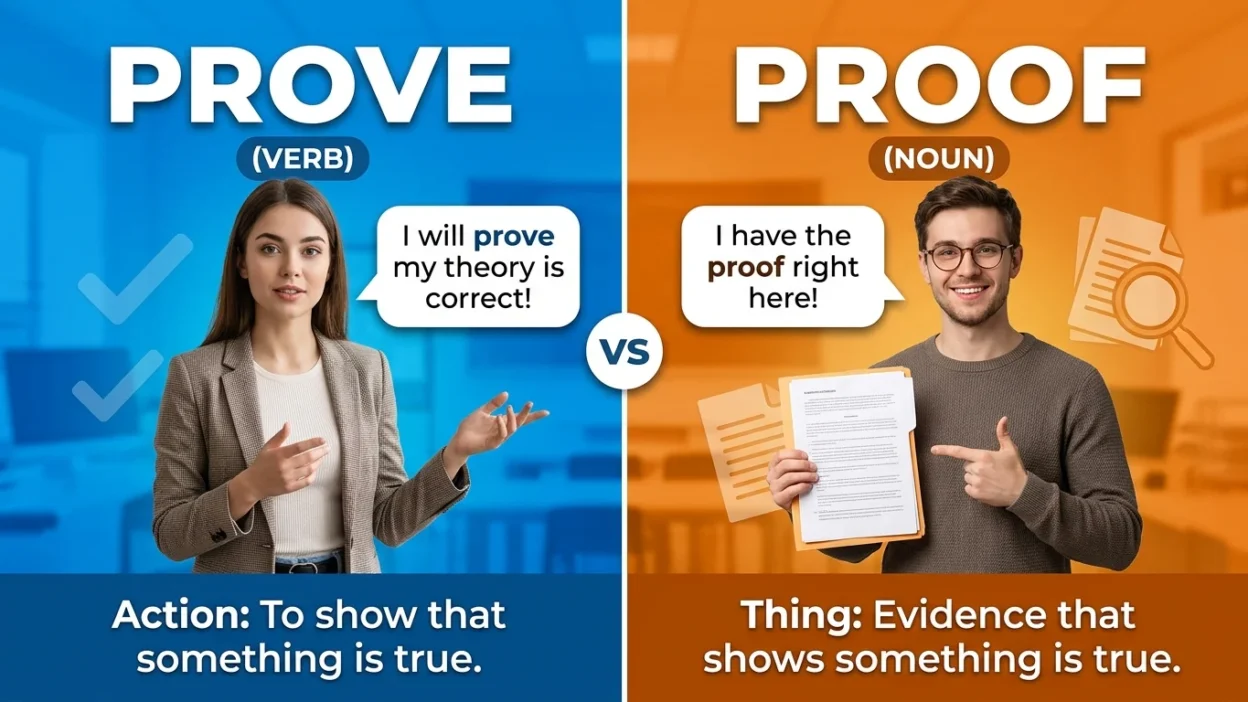
Have you ever wondered whether to use prove or proof in a sentence? These two words are closely related, but they have different meanings and grammatical uses. Prove is mainly a verb meaning to demonstrate that something is true, correct, or valid. Proof is usually a noun referring to evidence that supports a statement or claim. However, proof can also function as a verb or adjective in certain contexts. For example, you can prove your answer by providing proof.
Understanding the difference between prove vs. proof will help you avoid common English grammar mistakes in school assignments, professional writing, everyday conversations, and academic work. Although both words are connected to evidence and truth, they cannot always replace each other. In this guide, you’ll learn their definitions, parts of speech, grammatical forms, pronunciation, sentence examples, common mistakes, and correct usage in simple American English.
Quick Answer: Prove vs. Proof
Prove is a verb meaning to show that something is true or correct. Proof is usually a noun meaning evidence that supports a claim. However, proof can also be used as a verb in expressions such as proofread or proof a document, and as an adjective meaning resistant to something. The correct choice depends on context.
Why Do People Confuse Prove and Proof?
People often confuse prove and proof because the words have similar spellings, related meanings, and almost identical pronunciation patterns.
Both words are connected to showing that something is true, but their grammatical functions are different.
- Prove: Primarily a verb that describes an action.
- Proof: Primarily a noun that identifies evidence or confirmation.
- Proof as a verb: Used in certain specialized contexts, such as checking printed material.
- Proof as an adjective: Used in compound words or expressions describing resistance, such as waterproof.
Consider these examples:
- Prove: I can prove that my answer is correct.
- Proof: I have proof that my answer is correct.
- Proof as a verb: The editor will proof the document before publication.
- Proof as an adjective: This jacket is waterproof.
The first sentence describes an action, while the second identifies evidence. The other examples show that proof has additional grammatical uses.
Understanding these differences makes it easier to choose the right word.
What Does Prove Mean?
Prove is a verb meaning to demonstrate, establish, or show that something is true, correct, or valid through evidence, facts, reasoning, or testing.
It is commonly used in mathematics, science, education, law, research, and everyday communication.
For example, a student may prove a mathematical statement by showing each step of the solution. Similarly, a lawyer may present evidence to prove that a person is innocent.
Prove: Definition, Part of Speech, and Pronunciation
- Word: Prove
- Definition: To demonstrate that something is true, correct, or valid.
- Part of speech: Verb
- Pronunciation: PROOV
- Base form: Prove
- Third-person singular: Proves
- Past tense: Proved
- Past participle: Proved or proven
- Present participle: Proving
- Related noun: Proof
5 Examples of Prove in Sentences
Here are five practical examples showing how to use prove in a sentence:
- She used scientific evidence to prove her theory.
- I can prove that I completed the assignment on time.
- The student worked carefully to prove the mathematical statement.
- His actions will prove that he is trustworthy.
- The investigation helped prove what really happened.
When Should You Use Prove?
Use prove when describing an action that demonstrates something is true, correct, or valid.
Common situations include:
- Showing that a statement is true.
- Demonstrating a mathematical solution.
- Supporting a scientific theory with evidence.
- Establishing someone’s innocence or responsibility.
- Showing that a person has a particular ability.
- Confirming that an explanation or claim is correct.
Example: The lawyer presented several documents to prove her client’s innocence.
Here, prove is correct because it describes the action of demonstrating something through evidence.
What Does Proof Mean?
Proof is primarily a noun meaning evidence, facts, or information that demonstrate something is true, correct, or valid.
It is commonly used in mathematics, science, law, education, business, and everyday communication.
For example, a receipt can serve as proof of purchase, while a photograph may provide proof that an event happened.
The word also has specialized meanings. In mathematics, a proof is a logical demonstration that a statement is true. In printing, a proof is a preliminary version of a document checked before final publication.
Proof: Definition, Part of Speech, and Pronunciation
- Word: Proof
- Definition: Evidence or information that demonstrates something is true or correct.
- Part of speech: Primarily a noun; also used as a verb and adjective in specific contexts.
- Pronunciation: PROOF
- Plural form: Proofs
- Related verb: Prove
5 Examples of Proof in Sentences
Here are five practical examples showing how to use proof in a sentence:
- The police found proof of his involvement in the incident.
- This receipt is proof that I paid for the product.
- The teacher asked the student to provide proof of the answer.
- There is no proof that the rumor is true.
- The scientist presented proof to support the research findings.
When Should You Use Proof?
Use proof when referring to evidence, information, or a logical demonstration that supports a claim.
Common situations include:
- Providing evidence in a legal case.
- Showing a receipt as proof of purchase.
- Supporting a scientific claim.
- Presenting a mathematical proof.
- Confirming someone’s identity.
- Demonstrating that an event or action happened.
Example: You need proof of identity to open a bank account.
Here, proof is correct because it refers to evidence or documentation, not an action.
Can Proof Be Used as a Verb or Adjective?
Yes. Although proof is most commonly used as a noun, it also has other grammatical uses.
1. Proof as a Noun
As a noun, proof means evidence, confirmation, or a demonstration that something is true.
Example: The receipt is proof of payment.
2. Proof as a Verb
As a verb, proof can mean to check printed material for errors or prepare something for printing. It is also used in expressions related to making something resistant to a particular substance or condition.
Examples:
- The editor will proof the article before publication.
- The printer proofed the pages before producing the final copies.
- The company treated the fabric to proof it against water.
In everyday writing, proofread is often the more familiar verb when referring to checking a document for spelling, grammar, and punctuation mistakes.
3. Proof as an Adjective
In adjective-like compound expressions, proof indicates that something is resistant to or protected against a particular condition or substance.
Examples:
- Waterproof: Resistant to water.
- Fireproof: Designed to resist fire.
- Bulletproof: Designed to resist bullets.
- Childproof: Designed to reduce risks to children.
Strictly speaking, many of these are compound adjectives ending in -proof. They do not mean that something is completely impossible to damage in every circumstance.
Prove vs. Proof: Key Differences
Although prove and proof are related words, they serve different grammatical purposes.
| Feature | Prove | Proof |
| Main meaning | To demonstrate something is true | Evidence that demonstrates something is true |
| Main part of speech | Verb | Noun |
| Other grammatical uses | Primarily a verb | Also a verb and adjective in specific contexts |
| Pronunciation | PROOV | PROOF |
| Past tense | Proved | Proofed in specialized verb uses |
| Past participle | Proved or proven | Proofed in specialized verb uses |
| Present participle | Proving | Proofing |
| Plural form | Not applicable | Proofs |
| Common phrase | Prove your innocence | Proof of identity |
| Example | I can prove my point. | I have proof of my point. |
The Main Difference Between Prove and Proof
The easiest way to understand the difference is to remember that prove is mainly an action, while proof is mainly evidence.
For example:
- You prove that a statement is correct.
- You provide proof that a statement is correct.
Another example:
- The detective tried to prove the suspect’s involvement.
- The detective discovered proof of the suspect’s involvement.
Both words are connected to the same idea, but they cannot always replace each other because they perform different grammatical functions.
Grammatical Forms of Prove and Proof
Understanding the grammatical forms of these words will help you use them correctly in different sentences.
1. Forms of the Verb Prove
The verb prove changes depending on the tense.
| Grammatical Form | Word | Example |
| Base form | Prove | I can prove my answer. |
| Third-person singular | Proves | She proves her point clearly. |
| Past tense | Proved | He proved his theory. |
| Past participle | Proved / Proven | The claim has been proven. |
| Present participle | Proving | They are proving their argument. |
Both proved and proven are accepted past participle forms.
Examples:
- She proved that the statement was correct.
- She has proven that the statement was correct.
- The method has been proved effective.
- This is a proven method.
The form proved is the simple past form and can also be a past participle. Proven is another accepted past participle, especially familiar in expressions such as proven results and proven methods.
2. Forms of the Noun Proof
Proof is usually an uncountable noun when referring generally to evidence.
Example:
There is enough proof to support the claim.
However, it can also be a countable noun when referring to individual mathematical demonstrations or separate preliminary versions of printed material.
Its plural form is proofs, not proofes.
Examples:
- The mathematician presented two different proofs.
- The printer sent three proofs for approval.
- The investigators collected several pieces of proof.
In everyday writing, evidence or pieces of evidence is often more natural when referring to separate supporting items.
3. Forms of Proof When Used as a Verb
When proof is used as a verb, it follows regular verb patterns in its specialized uses.
| Grammatical Form | Word | Example |
| Base form | Proof | Please proof the document. |
| Third-person singular | Proofs | She proofs the pages. |
| Past tense | Proofed | He proofed the article. |
| Past participle | Proofed | The document has been proofed. |
| Present participle | Proofing | They are proofing the final pages. |
Remember that the verb proof is not a replacement for prove when you mean demonstrating that something is true.
How to Use Prove and Proof in the Same Sentence
You can use both words together because they have different grammatical roles.
Here are five examples:
- The documents prove that he made the payment and provide proof of the transaction.
- She used the evidence to prove her explanation and offered proof to support it.
- The receipt helped prove the purchase and served as proof of payment.
- The experiment may prove the theory if enough proof supports the results.
- He wanted to prove his innocence by presenting proof to the court.
Notice that prove describes what someone does, while proof identifies the supporting evidence.
12 Additional Practical Examples of Prove vs. Proof
These examples show how the two words work in everyday, academic, professional, and technical situations.
| Situation | Example |
| Education | The student must prove that the answer is correct. |
| Mathematics | The teacher explained the proof of the theorem. |
| Science | Researchers are trying to prove the hypothesis. |
| Law | The lawyer presented proof of innocence. |
| Business | The company must prove its financial claims. |
| Shopping | Keep your receipt as proof of purchase. |
| Identity | A passport can serve as proof of identity. |
| Personal achievement | Her success will prove her abilities. |
| Research | The study provides proof of the results. |
| Everyday conversation | I can prove that I was there. |
| Technology | The test results provide proof that the system works. |
| Workplace | He proved that he could complete the project successfully. |
Common Mistakes When Using Prove and Proof
English learners and writers sometimes confuse these words because their meanings are related. Here are five common mistakes and their corrections.
Mistake 1: Using Proof Instead of Prove
Incorrect: I can proof that my answer is correct.
Correct: I can prove that my answer is correct.
Why? Can is a modal verb, so it must be followed by the base form of a verb. In this sentence, prove is the correct choice.
Mistake 2: Using Prove Instead of Proof
Incorrect: I need prove of your address.
Correct: I need proof of your address.
Why? The sentence needs a noun referring to evidence or documentation. Therefore, proof is correct.
Mistake 3: Writing Proofed Instead of Proved
Incorrect: She proofed that the statement was true.
Correct: She proved that the statement was true.
Why? The past tense of prove is proved. The word proofed has specialized uses, such as checking printed material, but it is not the standard past tense of prove.
Mistake 4: Using Proofs as a Verb
Incorrect: He proofs his theory with research.
Correct: He proves his theory with research.
Why? Proofs is the plural form of the noun proof or a specialized verb form. When describing the action of demonstrating that a theory is true, use proves.
Mistake 5: Confusing Proved and Proven
Both forms are correct, but their grammatical use depends on the sentence.
Examples:
- Correct: She proved her point.
- Correct: She has proven her point.
- Correct: This is a proven method.
Remember that proved is the simple past form, while both proved and proven can be used as past participles.
An Easy Memory Trick to Remember Prove vs. Proof
Here is a simple trick to remember the difference:
Prove = Perform an Action
Think of showing, demonstrating, or establishing that something is true.
Example: I will prove that my answer is correct.
Proof = Evidence
Think of documents, facts, receipts, photographs, or information that support a claim.
Example: I have proof that my answer is correct.
Remember:
- Prove: What you do.
- Proof: What you have or provide.
A simple sentence to remember both words is:
You prove your point by providing proof.
American vs. British English: Is There a Difference?
There is no meaningful spelling difference between prove and proof in American and British English. Both varieties use the same spellings and basic grammatical distinctions.
For example:
- American English: I can prove that the information is correct.
- British English: I can prove that the information is correct.
Similarly, proof of identity, proof of purchase, and mathematical proof are standard expressions in both varieties.
The difference between these words is grammatical, not regional. You can use the same basic rules in American and British English.
Similar and Related Words
Several English words have meanings related to prove and proof. Understanding them can help you choose more precise vocabulary.
| Word | Meaning | Example |
| Evidence | Information that supports a claim | The evidence supports his explanation. |
| Demonstrate | To show how something works or is true | The experiment demonstrates the result. |
| Verify | To check that something is accurate | Please verify your email address. |
| Confirm | To establish that something is correct | The report confirms the findings. |
| Validate | To establish that something is acceptable or valid | The test validates the results. |
| Establish | To show or demonstrate something firmly | The investigation established the facts. |
| Substantiate | To support a claim with evidence | The documents substantiate her statement. |
| Disprove | To show that something is false | The new findings disprove the theory. |
These synonyms of prove, words related to proof, and other terms can make your writing clearer and more accurate.
FAQs
1. What Is the Difference Between Prove and Proof?
Prove is mainly a verb meaning to demonstrate that something is true or correct. Proof is usually a noun meaning evidence that supports a claim. For example, you prove your identity by showing proof of identity, such as an accepted document.
2. Is Proof a Verb or a Noun?
Proof is primarily a noun, referring to evidence or a logical demonstration. However, it can also be a verb meaning to check printed material or prepare something for printing. It also appears in adjective-like compounds such as waterproof and fireproof.
3. Is Prove a Verb or a Noun?
Prove is a verb that describes the action of showing that something is true, correct, or valid. For example, “She used facts to prove her argument.” Its grammatical forms include proves, proved, proven, and proving.
4. What Is the Past Tense of Prove?
The past tense of prove is proved. For example, “He proved that the answer was correct.” Its past participle can be either proved or proven, depending on the sentence and writing preference.
5. Is It Proof or Prove of Purchase?
The correct expression is proof of purchase. It refers to evidence that someone bought a product or service. A receipt, invoice, or other accepted transaction record may serve as proof of purchase.
6. Can You Say Proven or Proved?
Yes. Both proven and proved are correct past participle forms of the verb prove. For example, “She has proven her point” and “She has proved her point” are both grammatically correct.
7. What Is the Plural of Proof?
The plural of proof is proofs. For example, “The mathematician presented two proofs of the theorem.” Do not write proofes, because that is not the correct plural spelling.
8. Is Proofed the Past Tense of Prove?
No. The standard past tense of prove is proved. Proofed is the past tense of the separate verb proof, which can mean checking printed material for errors or preparing something for printing.
Remember This: Prove vs. Proof
- Prove is primarily a verb that describes an action.
- Proof is primarily a noun that refers to evidence.
- Proof can also function as a verb and appear in adjective-like compounds.
- The past tense of prove is proved.
- The past participle of prove can be proved or proven.
- The plural of proof is proofs.
- Proof of purchase and proof of identity are common expressions.
- Both words are spelled the same way in American and British English.
Conclusion
The difference between prove vs. proof is mainly their meaning and grammatical function. Prove is a verb that describes the action of demonstrating that something is true, correct, or valid. Proof is usually a noun that refers to evidence, facts, or information supporting that claim. However, proof can also function as a verb in specialized contexts and appear in adjective-like expressions such as waterproof and fireproof. Understanding these uses will help you choose the correct word in different situations.
The easiest way to remember the difference is simple: you prove something by providing proof. Use prove when describing an action and proof when referring to evidence or confirmation. Remembering this rule, along with the additional grammatical uses of proof, will help you avoid common English mistakes and communicate more clearly in everyday conversations, academic assignments, and professional writing.

Nathan Collins is a dedicated American author and content researcher with years of experience in digital publishing. He is passionate about writing clear, accurate, and engaging articles for a wide audience. His areas of interest include faith, history, culture, symbolism, and educational content. Nathan values honest research and strives to present information in a simple and balanced way. He believes that quality writing can inform, encourage, and inspire readers every day. His approachable style makes even detailed topics easy to understand. In his free time, Nathan enjoys reading historical books, outdoor activities, and lifelong learning. He is committed to creating reliable content that helps readers make informed decisions.